
How to Reduce Sports No-Shows in Pickup Games
How to Reduce Sports No-Shows in Pickup Games
The fastest way to cut no-shows is stacking four things at once: a clear RSVP with confirmation, automated reminders, a live waitlist, and a payment or commitment method tied to the roster. Layer in games players actually enjoy and feel invested in, since flaky attendance often traces back to low enjoyment rather than bad memory. Roster Sports builds these tactics into one system for organizers who want to stop chasing texts and start filling rosters.
TL;DR:
- Starting with a clear RSVP link and automated reminders can significantly reduce no-shows by addressing common response ambiguity and forgetfulness.
- An active waitlist that auto-fills based on reliability, proximity, and quick responses keeps rosters full despite cancellations.
- Creating enjoyable formats, social rituals, and recognition increases personal investment, leading to higher ongoing attendance from motivated players.
- Implementing upfront or season payments, along with straightforward cancellation policies, shifts behavior and reduces last-minute dropouts.
- Tracking and measuring changes over 30 to 60 days with key metrics like fill rate and attendance rates helps organizers assess and improve their no-show reduction strategies.
Table of Contents
- Priority Checklist To Reduce Sports No-Shows
- How Do You Set Up Reminders And Waitlists That Actually Work?
- Why Enjoyment And Investment Predict Who Shows Up
- Which Payment And Cancellation Policies Actually Work?
- How To Pilot And Measure No-Show Improvements
- What I'd Tell Any Organizer Starting Over Today
- Let Roster Sports Handle The Logistics You're Tired Of Chasing
- Sources
Priority Checklist To Reduce Sports No-Shows
Not every organizer needs every tactic at once. Start with whichever gap costs your group the most players right now, then add the rest as your group grows.
- Clear RSVP with confirmation. A single link beats a group chat every time, because ambiguity ("is Mike in or not?") is where most no-shows start. First test: replace your next group text with one shared signup link and see how fast responses come in.
- Automated multi-touch reminders. A reminder 48 hours out and another the morning of the game catches both forgetters and last-minute waverers. First test: send two reminders instead of one for your next three sessions and track who drops off.
- Active waitlist with auto-fill. An open spot that fills itself in minutes, not hours, keeps your roster full even after late cancellations. First test: designate two players as standing waitlist backups this week.
- Up-front or season payment. Money on the line changes behavior; a paid spot is a claimed spot. First test: try a small deposit for one high-demand session and compare turnout.
- One-tap cancellation and swap. Make quitting a spot as easy as claiming one, so cancellations happen early enough to matter. First test: ask cancelers to name a replacement themselves before you step in.
- Enjoyment and personal investment. Games people look forward to get better attendance than games people merely tolerate. First test: rotate in one new format or ritual and watch whether return rate improves.
Pro Tip: If you only have time to fix one thing this month, fix the waitlist. A dead roster spot is the single most visible symptom of a no-show problem, and auto-fill solves it without asking anyone to change their behavior.
How Do You Set Up Reminders And Waitlists That Actually Work?
Timing matters more than volume. Most organizers over-message everyone equally and still get surprised by no-shows, because a single generic reminder ignores how differently people actually behave.
- Send a confirmation request the moment a game is posted, not the night before.
- Follow with a reminder 48 hours out for casual weekly games, and 24 hours out for high-demand or paid sessions.
- Add a same-day reminder three to four hours before kickoff, timed to when players are usually near a phone rather than asleep or at work.
- Set an explicit cancellation deadline in every reminder ("cancel by 6 PM if you can't make it") instead of leaving it open-ended.
Reminder timing works best when it accounts for how someone has behaved before. Players who habitually confirm the same day can get a later nudge, while players with a history of late cancellations need an earlier prompt and a firmer deadline, according to scheduling research on behavior-based reminders. That single adjustment often does more than adding a third or fourth reminder to everyone.
Waitlist auto-promotion should rank candidates by three things: past reliability (has this person shown up when they said they would), proximity or availability for that specific time slot, and how recently they responded to the open-spot alert. A player who answers in two minutes and has a clean attendance record should always jump ahead of someone who takes an hour to reply, even if that second person joined the waitlist first.
Message templates matter more than most organizers assume. Keep them short, name the game and time in the first line, and frame the ask socially rather than administratively: "We need one more for Thursday, 7 PM, first to reply is in" works better than a bare status update.

Pro Tip: Build your cancellation deadline into the confirmation message itself, not just the reminder. Players plan around the first message they read, not the last one.
Why Enjoyment And Investment Predict Who Shows Up
Players who enjoy a game and feel personally invested in it are the ones who show up consistently, even when life gets busy. Research on adult recreational soccer players found enjoyment and personal investment to be the two strongest predictors of ongoing commitment, ahead of factors like skill level or social pressure, according to a study on sport commitment among adult recreational players. That's a structural finding, not a personality trait. Organizers can build it.
Format matters here too. Games with a task-focused, mastery-oriented climate (cooperative drills, clear skill progression, effort rewarded over raw talent) produce higher team commitment and lower "I only show up because I feel obligated" attendance, according to recent research on person-centered commitment profiles.
Practical levers that build both enjoyment and investment:
- Keep formats and team divisions consistent week to week so players know what to expect.
- Add small social rituals, like a post-game recap message or a standing group photo.
- Assign informal roles (a captain, a stats tracker, a music playlist owner) so people feel ownership beyond just filling a slot.
- Track and publicly recognize attendance streaks; a visible "5 games in a row" callout works as social proof.
- Sell season passes or track cumulative attendance, since skipping a game you've already paid into or built a streak on feels like a real loss, not a neutral choice.
The Recreational Sport Commitment Questionnaire confirms this pattern: enjoyment, desire to improve, and social support are the strongest drivers of what researchers call "enthusiastic commitment," the kind that shows up rain or shine rather than only when nothing better comes up.
Which Payment And Cancellation Policies Actually Work?
Money changes behavior faster than any reminder can. A player who has already paid for a spot treats it differently than one who simply said "yes" in a group chat, and that difference shows up directly in show rates.
Three payment models fit different group types:
- Season fees paid up front work best for recurring leagues with fixed rosters, since they lock in commitment before the season even starts.
- Per-session prepayment suits drop-in or rotating groups where attendance varies week to week and you need flexibility without losing the commitment effect.
- Optional paid reservations work for casual pickup groups not ready for full payment structure, letting players reserve a guaranteed spot for a small fee while others play free.
Cancellation policy should be simple and stated the same way every time: a full refund or credit if canceled 24 to 48 hours ahead, no refund inside that window unless a replacement is found. Publish the window once in your group's shared rules rather than re-explaining it every week.
Chasing individual Venmo payments session by session eats more organizer time than almost any other task, and it's worth standardizing instead of doing it manually. Collecting fees up front for a season, or automating tracking of who's paid, removes that friction entirely. Keep consequences for late cancellation low-friction too: a small fee or a lost priority slot next time works better than public shaming, which tends to just make people stop responding altogether.
How To Pilot And Measure No-Show Improvements
You don't need a full season to know if a tactic works. A tight 30 to 60 day pilot, similar to what's recommended in scheduling research, gives you a clean read on impact.
- Set a baseline. Track show rate (attended divided by rostered), cancellation rate, fill rate on open spots, and revenue per session for two to three weeks before changing anything.
- Pick one or two interventions. Adding a second reminder and an auto-fill waitlist is enough to test at once; more than that muddies which change actually worked.
- Run it for 30 to 60 days. Long enough to smooth out one bad week, short enough to course-correct quickly.
- Evaluate and scale. Compare against baseline and keep whatever moved the numbers.
| Metric | What to track |
|---|---|
| Show rate | Players who attended ÷ players rostered |
| Cancellation rate | Cancellations ÷ total RSVPs |
| Fill rate | Open spots filled before game time ÷ total open spots |
| Revenue per session | Total collected ÷ number of sessions |
A rising fill rate with a flat show rate still counts as progress. It means your waitlist is doing its job even if the original no-show behavior hasn't fully changed yet.
What I'd Tell Any Organizer Starting Over Today
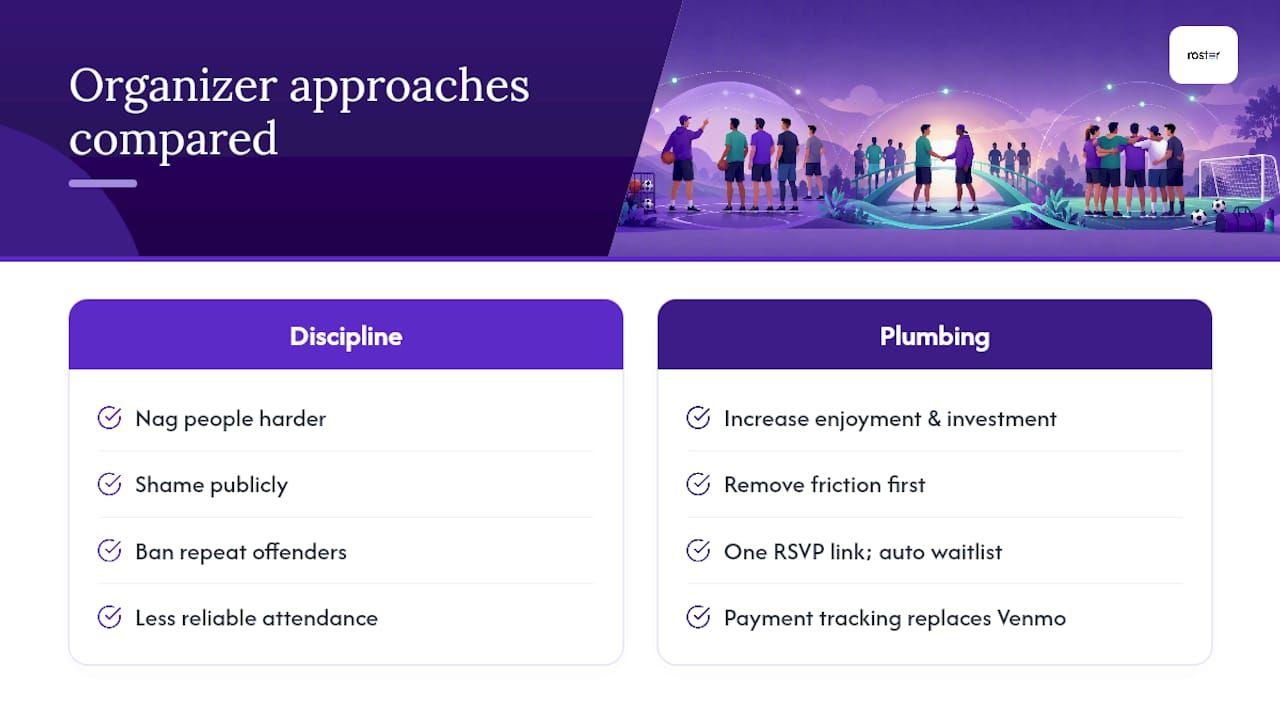
Most attendance advice treats no-shows as a discipline problem: nag people harder, shame them publicly, ban repeat offenders. That's backwards. The research on sport commitment is consistent that enjoyment and investment predict attendance far more reliably than guilt does, and operationally, friction kills attendance faster than forgetfulness does. Fix the friction first.
Roster Sports maps directly onto the tactics that matter here: one RSVP link instead of a group chat, a waitlist that auto-fills the moment someone drops, and payment tracking that replaces the weekly Venmo hunt. None of that is flashy. It's just the plumbing that lets the fun part of organizing, the actual game, happen more often with fewer gaps in the roster.
— Daniel
Let Roster Sports Handle The Logistics You're Tired Of Chasing
Every tactic in this guide, the single RSVP link, the auto-filling waitlist, the payment tracking that skips the Venmo chase, is built into Roster Sports as one connected system instead of five separate habits you have to maintain manually.
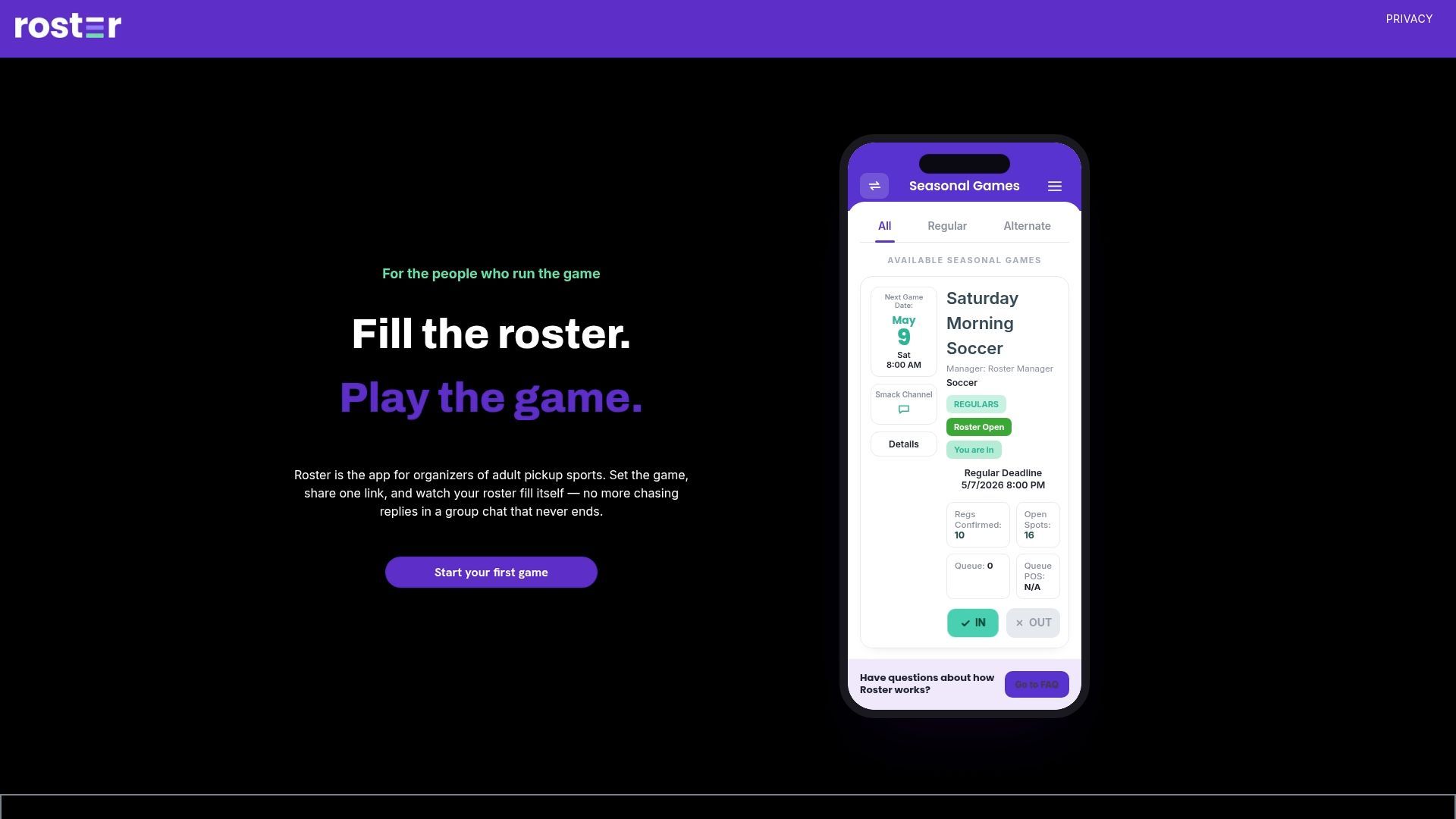
Post a game, share one link, and let regulars and alternates fill in real time while dropouts get automatically replaced from your waitlist. Payment tracking runs in the background so you're not manually reconciling who paid for Thursday's game three weeks later. If you're currently running attendance through a group chat and a mental spreadsheet, set up your first game link and see how much of that admin disappears on its own.
Sources
- Sport Commitment Among Adult Recreational Soccer Players: Test of an Expanded Model (IJES)
- Smarter scheduling to reduce no-shows and boost revenue
- Person-centered profiles and commitment in team sports (2026 DOI)
- Assessing sport commitment: development and validation of recreational sport commitment questionnaire (BMC Public Health)
Recommended