

A No-Show Fee Policy That Keeps Pickup Games Full
A No-Show Fee Policy That Keeps Pickup Games Full

A fair no-show fee policy protects play and prioritizes waitlisted players: confirm a refundable deposit or tiered cancellation window, apply a check-in deadline, and waive fees for documented emergencies. That single sentence is your policy. Copy it into your signup page today and adjust the numbers to fit your sport and group.
The point isn't to punish anyone. A no-show fee policy exists because empty spots that could have gone to someone on the waitlist are the real cost, not hurt feelings. Two things make this work without turning you into the bad guy:
- Who it covers: confirmed players and rostered alternates who fail to cancel before your check-in deadline, not people who give reasonable notice.
- Why automation matters: a tool like Roster Sports tracks RSVPs, fills open spots from a waitlist in real time, and removes the awkward job of chasing people down for money.
TL;DR:
- Using tiered cancellation windows and deposits encourages timely cancellations, reducing last-minute no-shows and associated last-minute planning issues.
- Automating RSVP tracking and waitlist management ensures open spots fill instantly, diminishing the need for harsh manual enforcement or disputes.
- Clear communication with reminders 12 to 48 hours before events, combined with a straightforward no-show fee, minimizes misunderstandings and last-minute absences.
- Accepting documented emergencies with a defined appeal process helps maintain fairness while upholding policy consistency.
- Keeping policies short, simple, and well-documented avoids confusion and encourages voluntary compliance from participants.
Table of Contents
- Copy-Ready No-Show Fee Policy Template
- How to Enforce the Policy Without Starting Arguments
- What to Say to Players Before and After a No-Show
- Setting Fees, Deposits, and Refund Rules
- Building In Fair Exceptions Without Losing Consistency
- Why Short Policies Beat Long Ones
- Key Takeaways
- Templates and Tools to Set This Up Today
- Sources
Copy-Ready No-Show Fee Policy Template
You don't need a legal document. You need three sentences players will actually read, plus a longer version for your handbook or league page.

Signup-line version (paste this directly into your registration form):
"Confirmed spots require a $10 deposit; cancel more than 24 hours before game time for a full refund, or forfeit it as a no-show fee."
Full policy version (for a season handbook or pinned group message):
- Cancellations made more than two days before the scheduled game receive a full refund or deposit release.
- Cancellations less than two days before but more than one day receive a partial refund, reflecting the reduced chance of filling the spot.
- Cancellations within one day, or unexcused no-shows, forfeit the full deposit or incur the standard no-show fee.
- Players must check in by the posted deadline (typically a short period before start) or their spot releases to the waitlist automatically.
Tiered windows like these show up across most organizer templates because they separate a late change of plans from a true no-show, and no-shows get treated more strictly because they wreck last-minute planning with zero warning.
Your policy also needs an exit ramp:
- Players may appeal a charge within seven days by messaging the organizer with supporting documentation.
- Organizers review appeals within 72 hours and respond in writing (a group chat reply counts).
- Accepted exceptions include medical emergencies, family emergencies, and organizer-side cancellations like weather.
Pro Tip: Post your "core versus optional" list right next to the fee policy. Games and required check-ins are core; pickup socials or optional scrimmages are not. That distinction alone prevents most disputes before they start, since ambiguity about what counts as mandatory is a leading cause of attendance conflict.
How to Enforce the Policy Without Starting Arguments
Enforcement fails when it's improvised mid-game. Build it into three phases and most conflicts disappear before they start.
- Before the game: set a quorum, usually the minimum headcount for a fair match, and lock the roster once it's hit. Collect a deposit or card-on-file if you're using one, and schedule an automated reminder so nobody forgets they signed up.
- On game day: open a check-in window, commonly 15 to 30 minutes pre-game, and mark no-shows the moment the deadline passes. Promote the next name on the waitlist immediately so the game stays full.
- After the game: log any incidents (late arrivals, no-shows, disputes) while details are fresh, then bill according to your policy, commonly seven days after the game. Save any appeal documentation in one place.
Quorum-based RSVPs work because they confirm a game only once enough players commit, so nobody shows up to a game that never had a real chance of happening. Automated waitlists take the pressure off you to enforce harsh penalties in the first place. If a spot fills the second someone drops, a strict fee stops being your only defense against a canceled game.
Pro Tip: Never mark a no-show manually in a group chat thread. Do it inside your roster tool so the record is timestamped and undisputed later.
What to Say to Players Before and After a No-Show
The wording matters almost as much as the policy itself. A reminder that sounds like a warning gets ignored. One that sounds like a favor gets acted on.
- 48-hour reminder: "You're confirmed for Thursday's 7pm run. Can't make it? Tap here to cancel and free your spot for someone on the waitlist."
- 12 to 24-hour reminder: "Game's tomorrow at 7pm. If your plans changed, cancel now, your deposit stays with you and someone else gets to play."
- No-show notice: "You were marked absent for Thursday's game without a cancellation. A $10 no-show fee applies per our policy. Reply here if you'd like to appeal."
A single well-timed reminder with an easy, one-tap cancel option does more to cut down last-minute no-shows than any fee ever will. Frame every message around protecting the group's ability to play, not around catching someone breaking a rule. For repeat offenders, escalate in writing: a first warning, then a temporary suspension, and only then removal from the roster, so nobody can claim they weren't told.
Setting Fees, Deposits, and Refund Rules
A deposit returned at check-in tends to outperform a flat penalty charged after the fact, mostly because it changes the psychology: players are protecting money they already have, not fearing a bill that might show up later. Small refundable deposits returned on attendance are one of the more consistent behavioral nudges organizer templates recommend.
- Deposit model: refundable at check-in, forfeited on no-show, easiest to automate.
- Strike model: no charge until a pattern emerges (two no-shows in a season, for example), gentler but harder to enforce evenly.
- Per-game charge model: billed automatically after every missed game, simplest for regulars who play weekly.
For amounts, scale to what's actually at stake. A $5 to $10 fee fits casual weekly pickup; team sports with rented court or field time and real per-head costs can justify $10 to $20. Keep refund windows generous (48 hours is standard) and allow transfers to a friend instead of a straight forfeiture when possible. Keep basic records: date, amount, reason, and any appeal notes, retained for at least one season in case a dispute resurfaces.
Building In Fair Exceptions Without Losing Consistency
A policy only holds up if players believe it's applied evenly, and that means deciding your exceptions before you need them, not while you're mid-argument with someone in your group chat.
- Accepted exceptions: documented medical emergencies, family emergencies, and organizer-initiated cancellations like weather, none of which should trigger a fee.
- Documentation: a brief note or message confirming the circumstance, not a demand for medical records.
- Repeat issues: treat a chronic pattern differently from a one-off; a written warning first, then a suspension, only removal as a last resort.
Well-documented attendance policies typically spell out accepted exceptions and a notification expectation up front. Give appeals a real deadline, seven days to submit, 72 hours for you to respond, so nobody is left wondering if their case got lost.
Why Short Policies Beat Long Ones
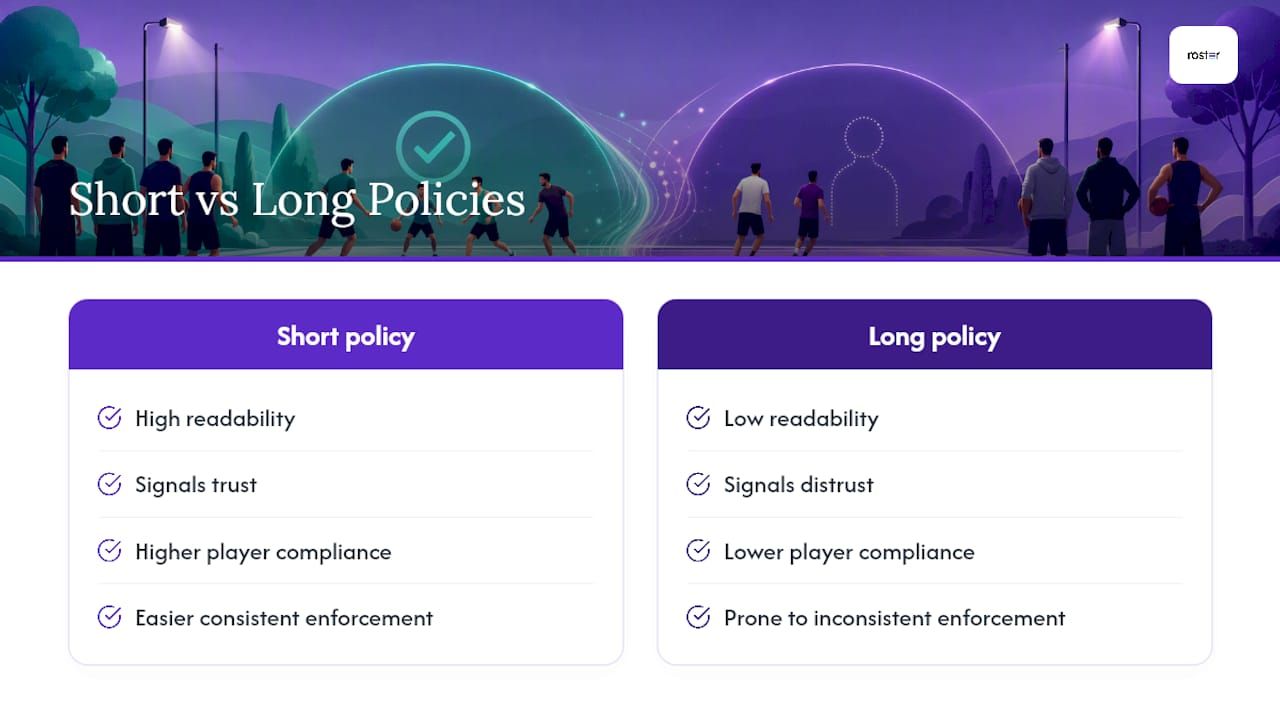
The best no-show policies I've seen run three sentences, not three pages. Length signals distrust, and players read it that way even when that's not the intent. Write the short version, publish it, then watch what actually happens for a month before you tighten anything.
Most of the friction I'd expect organizers to hit doesn't come from the fee itself. It comes from inconsistent enforcement, one player getting charged and another getting a pass. Automation solves that better than any wording ever could, because a roster tool applies the same rule to everyone without playing favorites or forgetting to send the bill.
— Daniel
Key Takeaways
A short, tiered no-show fee policy enforced through automated check-ins and waitlists reduces disputes far more effectively than a strict penalty applied inconsistently by hand.
| Point | Details |
|---|---|
| Lead with a copy-ready sentence | State the deposit amount and cancellation window in one sentence players can find on your signup page. |
| Use tiered cancellation windows | Full refund beyond 48 hours, partial refund 24 to 48 hours, forfeiture under 24 hours. |
| Automate check-ins and waitlists | Tools like Roster Sports fill open spots instantly, cutting the need for harsh manual penalties. |
| Document exceptions upfront | Accept medical and family emergencies with brief documentation, and set a seven-day appeal window. |
| Bill consistently, not personally | Charge every no-show the same way, roughly seven days after the game, and keep basic records. |
Templates and Tools to Set This Up Today
- Cancellation and no-show policy templates for tiered windows and deposit language.
- PMBA attendance policy example for exceptions and appeals wording.
- Roster Sports to automate RSVPs, waitlists, and billing so the policy runs itself.
Sources
Recommended