September 19, 2026
30 Seconds to Full Prep: Balance Teams by Skill for Pickup Organizers


If you need fair pickup teams fast, rate each player 1 to 5 and run a snake draft or a simple seeded shuffle. Reach for an optimizer only when you have real constraints, like players who can't be split up or a group that hates seeing the same matchups every week.
TL;DR:
- Using a snake draft or seeded method requires only consistent player ratings and is suitable for most casual team balancing needs.
- Optimization tools are best for leagues with complex constraints and recurring rosters, offering the most precise skill balance.
- Quickly assessing players with simple ratings and swapping 1-2 players can correct imbalances that exceed a 1 to 2 point skill gap.
- Streamlining roster management via apps or CSV exports reduces admin time and improves accuracy in team formation before each game.
- Trust in a transparent, rule-based approach helps prevent complaints about stacking, especially when communicating team balance simply.
Table of Contents
- How Do You Balance Teams by Skill?
- Step-by-Step: Turning Ratings Into Balanced Teams
- Quick Workflows for Every Time Budget
- Which Tool Should You Use to Balance Teams?
- How Do You Rate Players Fairly and Keep Ratings Current?
- How Roster-Building Actually Works Week to Week
- When Should You Accept an Imperfect Balance?
- Let Roster Handle the Roster Side So You Can Focus on the Split
- Sources
- FAQ
How Do You Balance Teams by Skill?
Balancing teams by skill comes down to picking one of five methods, each trading off fairness, speed, and how easy it is to explain to a skeptical player standing on the sideline.
Snake draft (serpentine draft) ranks everyone by rating, then alternates pick order back and forth (Team A, B, C, C, B, A, A, B, C…) so the best players spread evenly, and no single team stacks the top tier. It's the gold standard for skill-based team formation because it's transparent. Anyone can watch it happen and see why the teams look the way they do.
Seeded plus random locks your top two or three players onto different teams first, then randomizes everyone else. It's faster than a full draft and still prevents the nightmare scenario where all four "ringers" land on one side.
Pure random skips skill entirely. It works fine for casual scrimmages, classroom activities, or icebreakers where social mixing matters more than a tight scoreline.
Captain picks hands the process to two captains alternating selections. It feels familiar from gym class, but it reliably produces uneven teams and can sting for players picked last.
Optimization tools run every possible combination through an algorithm to minimize the skill gap while respecting rules like "these two can't be on the same team again." Save this for leagues with recurring rosters and real constraints.
-
Snake draft: fair, transparent, slower with large groups
-
Seeded + random: fast, decent balance, less rigorous than a full draft
-
Pure random: instant, socially neutral, weak skill balance
-
Captain picks: familiar, but often the least fair option
-
Optimization: strongest balance, needs data entry and a tool
Step-by-Step: Turning Ratings Into Balanced Teams
Getting from a list of names to two evenly matched rosters takes five steps, and skipping any of them is usually where organizers get burned.
- Decide team count vs. team size. If you have 20 players and want 5-a-side games, that's 4 teams. If your venue caps you at 3 teams, work backward from there instead.
- Rate every player on a 1 to 5 scale. Use short descriptors: 1 (brand new), 3 (solid recreational player), 5 (plays competitively or dominates most games). Consistency matters more than precision.
- Apply your chosen method. For a snake draft, sort by rating and alternate assignment direction each round. For seeded plus random, place your top-rated players on different teams first, then shuffle the rest. For an optimizer, import your roster as a CSV, set your constraints, and export the result.
- Calculate a quick balance score. Add up each team's total skill rating and check the spread. A gap of 1 to 2 points across 10 players is usually fine; anything wider needs adjusting.
- Make a 1 to 2 player swap if needed. Trade one mid-tier player between the two most lopsided teams rather than rebuilding from scratch.
When you announce teams, say something simple like "teams are balanced within one point average skill" rather than posting raw ratings. Practitioners who expose a basic balance indicator instead of individual scores tend to see fewer complaints about "stacked" rosters, because players can see the logic without feeling personally graded.
Pro Tip: Keep a running note of swaps you make and why. If the same two players keep getting flagged as imbalance sources, that's a signal your ratings need a refresh, not that your method is broken.
Quick Workflows for Every Time Budget
Not every game night deserves a spreadsheet. Match your effort to how much time you actually have.
- 30 seconds: Eyeball each player as a 1, 2, or 3, then run a snake draft in your head as people walk in. Good enough for a casual weeknight run.
- 5 minutes: Send a quick poll or use in-app ratings from returning players, seed your top two, and shuffle the rest. Share teams in your group chat.
- Full prep (before a season or tournament): Collect ratings ahead of time, run everything through an optimizer with constraints set, and publish the balance metric alongside team names.
For odd numbers, the cleanest fix is a rotating bench: the extra player sits out one game per round on a schedule everyone can see coming. If you're managing substitutes, treat them as a separate skill-rated pool so they can slot into whichever team needs help that week rather than always landing on the same side.
Which Tool Should You Use to Balance Teams?
Tool choice depends on how complicated your constraints are, not how many players you have.
Simple randomizers are the fastest option and the easiest to trust because there's nothing hidden. A random team generator that offers a skill-balanced snake-draft mode alongside pure random, plus a balance score showing how even the split is, covers most casual needs in one click.
Snake-draft generators sit in the middle. They automate the alternating pick order and usually display the resulting balance so you can defend your teams if someone questions them.
Optimization-based tools, like the open-source Team Balancer, use simulated annealing to test thousands of arrangements and land on one that minimizes skill imbalance while honoring rules like "avoid repeat teammates." That approach can weight competing priorities in ways a hand shuffle simply can't manage once you have more than one constraint.
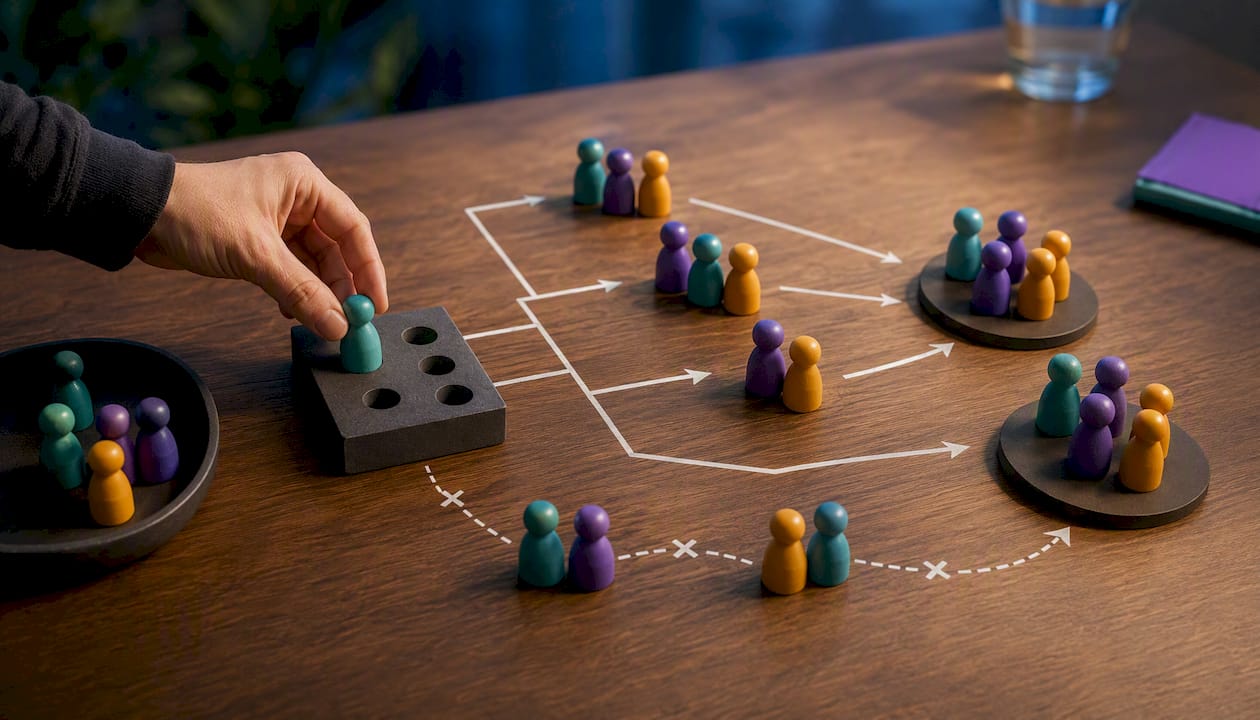
For context, newer research into neural and probabilistic team-formation models shows meaningful accuracy gains over older heuristics on large datasets. Interesting territory, but it's research-grade computing built for academic benchmarks, not something a weekend soccer organizer needs to touch.
Before picking a tool, check for:
- CSV import and export support
- Configurable constraints (avoid repeats, cap tier stacking)
- Mobile compatibility for last-minute changes
- No account or data-sharing requirement if privacy matters to your group
How Do You Rate Players Fairly and Keep Ratings Current?
A rating system only works if players trust it, and trust comes from consistency, not perfection.
Start with a clear 1 to 5 scale using short, specific descriptors for each tier rather than vague labels like "good" or "great." A hybrid approach works well: the organizer sets an initial rating, players optionally self-rate, and the organizer calibrates the two against each other before finalizing anything.
Structured skill assessments that combine observation with self-reported data tend to hold up better over time than either method alone, and the same principle applies to a weekend basketball league as it does to a workplace team.
- Re-rate quarterly for active weekly groups, seasonally for casual ones
- Track attendance and reliability as a separate modifier, not folded into skill
- Share team-level stats publicly, keep individual scores private
- Offer a low-friction way for players to flag a rating they disagree with
Pro Tip: A player who rarely shows up shouldn't get the same weight as a regular with the same skill level. Downgrade their reliability score separately so a no-show doesn't quietly wreck your balance calculation the one week they do appear.
How Roster-Building Actually Works Week to Week
In practice, balancing skill is one step inside a longer roster cycle. An organizer publishes a game, collects RSVPs, and pulls ratings for returning players from memory or a saved list. From there, exporting the roster as a CSV lets you feed it into a generator or optimizer without retyping names.
Automating the RSVP and waitlist side of that cycle, the way a roster app handles signups, frees up the time you'd otherwise spend chasing replies, so more of it goes toward getting the skill split right. Post teams with a one-line balance note, like "average skill gap: 0.4," and you'll field fewer "why is my team worse" messages.
When Should You Accept an Imperfect Balance?
Sometimes perfect balance isn't the goal; consulting with experienced padel coaches & trainers in Lithuania can help tailor your team formation approach to specific skill gaps. Mentorship nights, social mixers, or a session where benching your best player keeps the game enjoyable for everyone else all call for a different priority. When you make that call, say so out loud, and let players know the reasoning behind it before the first whistle.
Let Roster Handle the Roster Side So You Can Focus on the Split
Roster Sports is built for the part of this process that eats the most time before you ever get to rating anyone: chasing RSVPs, managing a waitlist, and figuring out who's actually showing up. Instead of tracking replies across multiple group chats, organizers can share one link and have open spots filled automatically as people sign up or drop out.
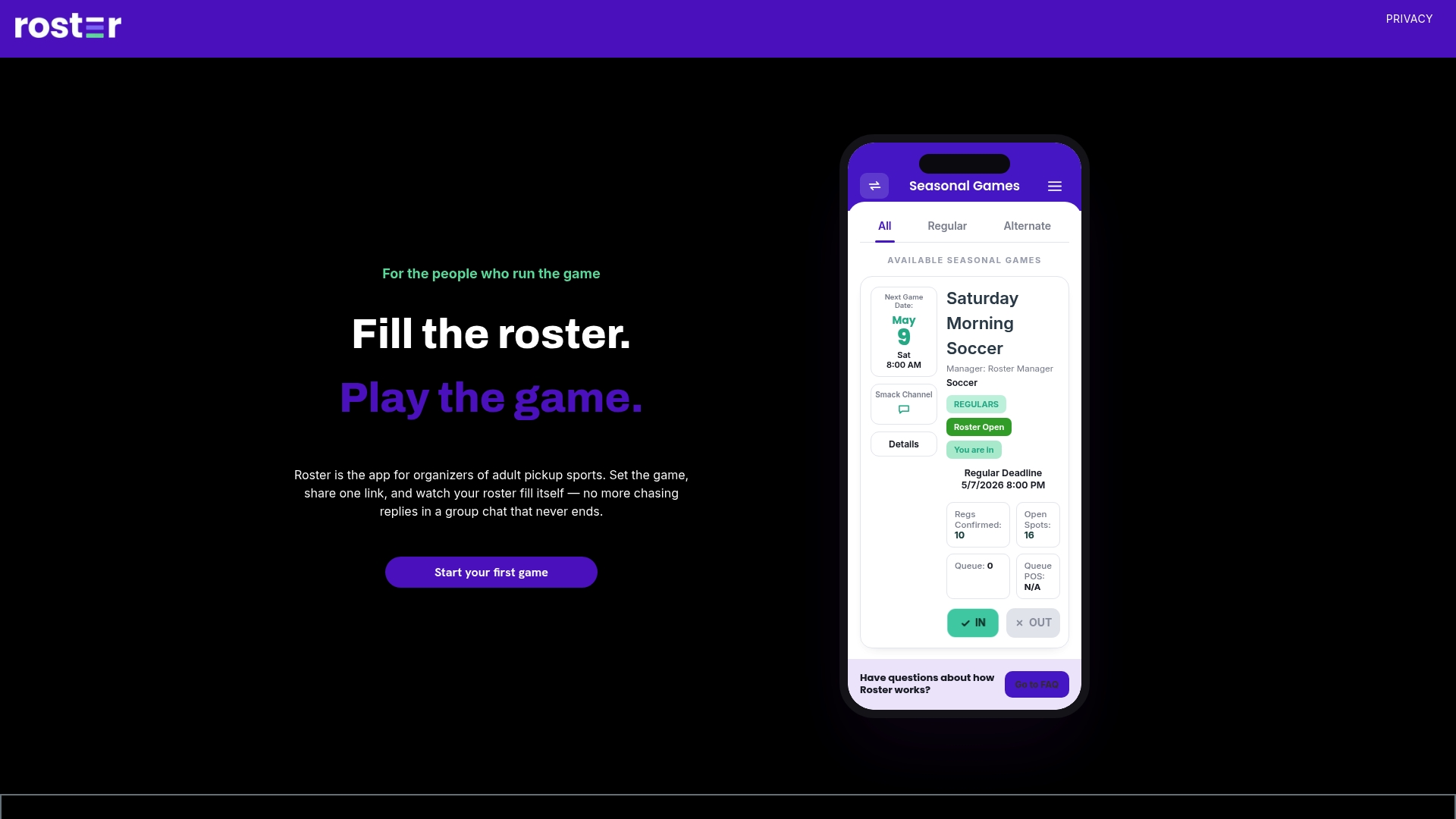
That means your player list is accurate by the time you're ready to rate skill and run a snake draft or feed a CSV into an optimizer. Try capturing player ratings using an app for your next few games, export the roster when it's time to split teams, and see how much less admin work is left once signups run themselves. Start by setting up your next game on Roster's main product page and see the roster fill in real time.
Sources
- The Manager's Guide to Conducting a Team-Wide Skill Assessment | Riot IQ
- DJSapit/team-balancer
- Random Team Generator — Split Players Into Balanced Teams
- A Variational Neural Architecture for Skill-based Team Formation (2026)
FAQ
What Are the 5 C's of a Balanced Team?
There's no single universally agreed "5 C's" framework specific to skill-balanced sports teams. If you're looking for team-building fundamentals more broadly, most versions emphasize communication, complementary skills, commitment, clarity of roles, and conflict resolution rather than a formal skill-rating system.
What Characteristics Hurt Team Balance?
Uneven skill distribution is the obvious culprit, but attendance unreliability, cliques that resist mixing, and captains who unconsciously favor friends during picks all quietly undo balance efforts. A structured skill assessment that separates skill from reliability helps catch these before they wreck a matchup.
What Is a Balanced Team, Exactly?
A balanced team is one where total or average skill rating is roughly even across rosters, typically within a point or two on a 1 to 5 scale. Tools like a random team generator's balance score quantify this automatically instead of leaving it to guesswork.
What Skills Matter Most for Effective Teamwork?
Beyond raw athletic skill, communication, reliability, positional awareness, and willingness to adapt to teammates all shape how a "balanced" roster actually performs on the field. That's why pairing a skill rating with an attendance or reliability modifier, and giving players a way to raise concerns through your roster app or group chat, tends to produce fairer outcomes than skill numbers alone.
Do I Need Special Software to Balance Teams by Skill?
No. A snake draft or seeded shuffle done by hand covers most casual pickup games in a few minutes. Reach for a tool like Team Balancer only when you're juggling multiple constraints, like avoiding repeat matchups across a full season.