November 5, 2026
Season Dues vs. Drop-In: Which Fee Model Fits Your Game


Season dues work best for a committed core of players who show up most weeks. Drop-in fees work best for casual, irregular attendance. Most healthy pickup games end up using both: regulars pay once for the season, and alternates pay per game when they fill an empty spot. This guide shows what U.S. organizers and facilities charge, how the two models behave in practice, and how to pick one without turning your group chat into a billing department.
TL;DR
- Season dues give organizers predictable money up front and reward commitment. Drop-in fees give players flexibility and cost nothing on weeks they skip.
- Published U.S. rates show the split clearly: single drop-in sessions often run $10 to $20, while monthly or seasonal plans lower the per-game cost for anyone who plays weekly.
- A hybrid works for most groups: regulars pay for the season, alternates pay per game.
- Whatever you choose, write down what dues cover, what happens if someone quits mid-season, and who collects the money.
- Per-player fees are easier to track and cover waivers and insurance more cleanly than one team-wide fee.
Table of Contents
- What each model actually means
- What U.S. players actually pay
- Season dues: where they shine
- Drop-in fees: where they shine
- The hybrid most organizers settle on
- Per-player fee or one team fee?
- How to set your number
- Rules to write down before you collect a dollar
- Perspective: why we think regulars plus alternates beats either extreme
- Which model fits your situation
- Run it from one link
- FAQ
- Sources
What each model actually means
Season dues are a single payment that covers a fixed block of games: eight weeks of Tuesday night soccer, a ten-week basketball run, a fall futsal season. The player is committing to a roster spot. The organizer is committing to a field, a gym or a referee for the whole block.
Drop-in (also called per-game or pay-as-you-go) means the player pays each time they show up. No commitment on either side. The organizer usually doesn't know in advance how many people will come.
The real difference is who carries the risk. Under season dues, the player carries it: if they skip three weeks, the money is spent anyway. Under drop-in, the organizer carries it: the field costs the same whether eight people or eighteen show up.

What U.S. players actually pay
Published prices make the trade-off concrete. These come from facilities and leagues that post their rates:
| Model | Example rate | Source type |
|---|---|---|
| Single drop-in session | $10 per session, free for members and pass holders | Community pickup association |
| Futsal drop-in | $15 per game, $10 for a member's guest | Indoor sports center |
| Futsal membership | $49 per month with organized games on set days | Indoor sports center |
| Soccer pickup, non-member | $20 per game | Soccer facility |
| Soccer pickup membership | $40 per month, unlimited pickup | Soccer facility |
| League season, per player | $70 per player for the fall 2026 season | Futsal league |
Do the math on the soccer facility: at $20 a game, a $40 monthly membership pays for itself on the second game of the month. That is the usual shape of the trade-off. Drop-in is priced a little high on purpose, so that anyone who plays regularly is nudged toward the plan.
The same futsal operator that sells the $70 season also cites an average of $6 per player per game for its adult league. A full season is cheaper per game than any drop-in rate in the table, which is the whole point of paying up front.

Per-game costs in team leagues
One Seattle league publishes average costs per person per game, and the numbers are tight: softball runs $14.50 on a team and $12 as an individual, kickball $11 either way, flag football $15 versus $12.50, and dodgeball $8.50 versus $6.25. Per-person game costs in adult rec leagues commonly land in the $6 to $15 range, depending on the sport and what is included (officials, equipment, venue).
Season dues: where they shine
You know your budget on day one. Field or gym rentals are usually booked and paid in blocks. If dues land before the first game, you aren't fronting rent from your own pocket. Our guide to what it costs to rent a soccer field shows how fast hourly rates add up across a season.
Commitment improves attendance. People who have paid for eight weeks tend to show up for eight weeks. That matters more than it sounds: a game with a reliable core is simply more fun, and fewer cancellations mean fewer wasted bookings.
It simplifies collection. One payment per player per season beats chasing $10 bills every Tuesday. Organizers who have spent a season tracking who paid for which week know exactly what this saves.
The catch: dues feel steep as a lump sum, and players with busy jobs or travel schedules may hesitate to commit. Make that easier with a clear refund or transfer rule.
Drop-in fees: where they shine
Low barrier for new players. A first-timer will try a $10 or $15 game far more readily than an $80 season. Drop-in is how new people discover a game.
Fair for irregular schedules. Nurses on rotating shifts, parents, people who travel for work: they pay only for what they use.
Fills gaps. When a regular drops out, a per-game rate gives you a simple, fair price to offer someone filling in.
The catch: revenue is unpredictable, and you need a collection method every single week. Without one, organizers end up covering the shortfall. Drop-in groups also tend to have more no-shows, since nobody has money on the line.
The hybrid most organizers settle on
The cleanest setup for a weekly pickup game has two tiers:
- Regulars commit to the season and pay once. They have a guaranteed spot.
- Alternates pay per game, only when they actually take a spot.
This mirrors what many facilities do with memberships plus a higher non-member drop-in rate. Drop-in costs more per game, so committing is rewarded, but the door stays open. One soccer facility's non-member rate is $20 a session against a $40 monthly pickup membership, and a large multi-sport platform even markets unlimited drop-ins through a pass.
For a volunteer-run game, you can borrow the structure without the complexity. Set a season price that covers the venue and any extras, then set an alternate price modestly above the regulars' effective per-game cost. If regulars effectively pay $7 a game, charging alternates $10 to $12 is easy to defend.
Per-player fee or one team fee?
If your game is organized into teams, you have a second choice: charge each player, or charge the team.
Team fees are common in facility leagues. One indoor soccer center lists nightly adult leagues at $1,000 per team, with a $100 discount for paying in full early and teams removed from the schedule if fees aren't settled by week five. Another league lets the captain pay the whole fee or split it so each player pays their share, and each sport has a minimum team size that must be paid for.
Per-player fees have a clear organizer-side logic. A Kansas City league explains that its captain pays a deposit and the player fee, after which each player signs up and pays individually. It says per-player charging gives it each person's contact information for rainout notices and makes it possible to collect waivers and cover insurance per player rather than per team.
For informal pickup, per-player is almost always simpler. There is no captain fronting hundreds of dollars and chasing teammates for repayment, and every player has a direct relationship with the organizer. If you do need waivers, our guide on collecting pickup game waivers walks through it.
How to set your number
Start from your real costs, not from what feels right.
- Add up fixed costs for the season. Field or gym rental, referee fees, equipment, insurance if you carry it. Our breakdown of pickup soccer costs using an $85-per-hour turf example shows the arithmetic.
- Decide how many paying regulars you need to cover that total, with a few alternates as a cushion rather than a requirement.
- Divide. Fixed costs divided by regulars gives the season price. Divide by the number of games for the effective per-game rate.
- Price alternates above that per-game rate, not below it.
- Round to a clean number. $70 is easier to collect than $68.43.
If your costs are more complicated, such as multiple fields or uneven attendance, splitting field costs fairly covers the common approaches.
Rules to write down before you collect a dollar
Most payment disputes in rec sports are not about the price. They are about the rules nobody stated. Put these in your signup message:
- What the fee covers. Games only, or also jerseys, referees, a post-game drink?
- When it is due. Before the first game works best.
- What happens if someone quits mid-season. Some programs are explicit: one soccer facility says a canceled league membership stays valid until the next monthly renewal date, after which the player pays per game. You can adopt a similar clear rule, such as a prorated transfer or a spot handed to someone on the waitlist.
- What happens with a rainout or cancellation. Credit, refund, or makeup game.
- How alternates are chosen and charged. First on the waitlist, billed per game.
A short, visible policy prevents the awkward conversation later.
Perspective: why we think regulars plus alternates beats either extreme
We built Roster around a simple observation: the people who organize adult pickup games are volunteers, and the money is rarely the hard part. The hard part is the chasing. Who's in, who paid, who's covering for the guy who bailed.
That is why we think the regulars-plus-alternates model fits pickup so well. Regulars are committed for the season. Alternates step in for individual games. Roster is designed around exactly this split, so the app tracks roster spots, fills open ones in real time and keeps a waitlist for dropouts, without you counting replies in a group chat.
Our own fees follow the same logic. Managers are billed per regular per season and per alternate per game, based on who was actually rostered, not on guesses. Players never pay us. Their only financial relationship is with their organizer, and peer-to-peer Venmo payment tracking helps you see who has settled up.
The goal isn't another screen. It is fewer messages and more people actually showing up on the field.
Daniel
Which model fits your situation
| Your game | Best fit |
|---|---|
| Same 12 to 16 people most weeks | Season dues |
| Open game, different faces each week | Drop-in |
| Core group plus a rotating bench | Season dues for regulars, per-game for alternates |
| Multi-team league with captains | Per-player fees, optionally with a captain's deposit |
| New group trying to build interest | Drop-in first, then offer a season once attendance stabilizes |
If you are launching something new, our guide to starting an adult rec league in one season covers timing and signup, and multi-team scheduling helps once the group grows.
Run it from one link
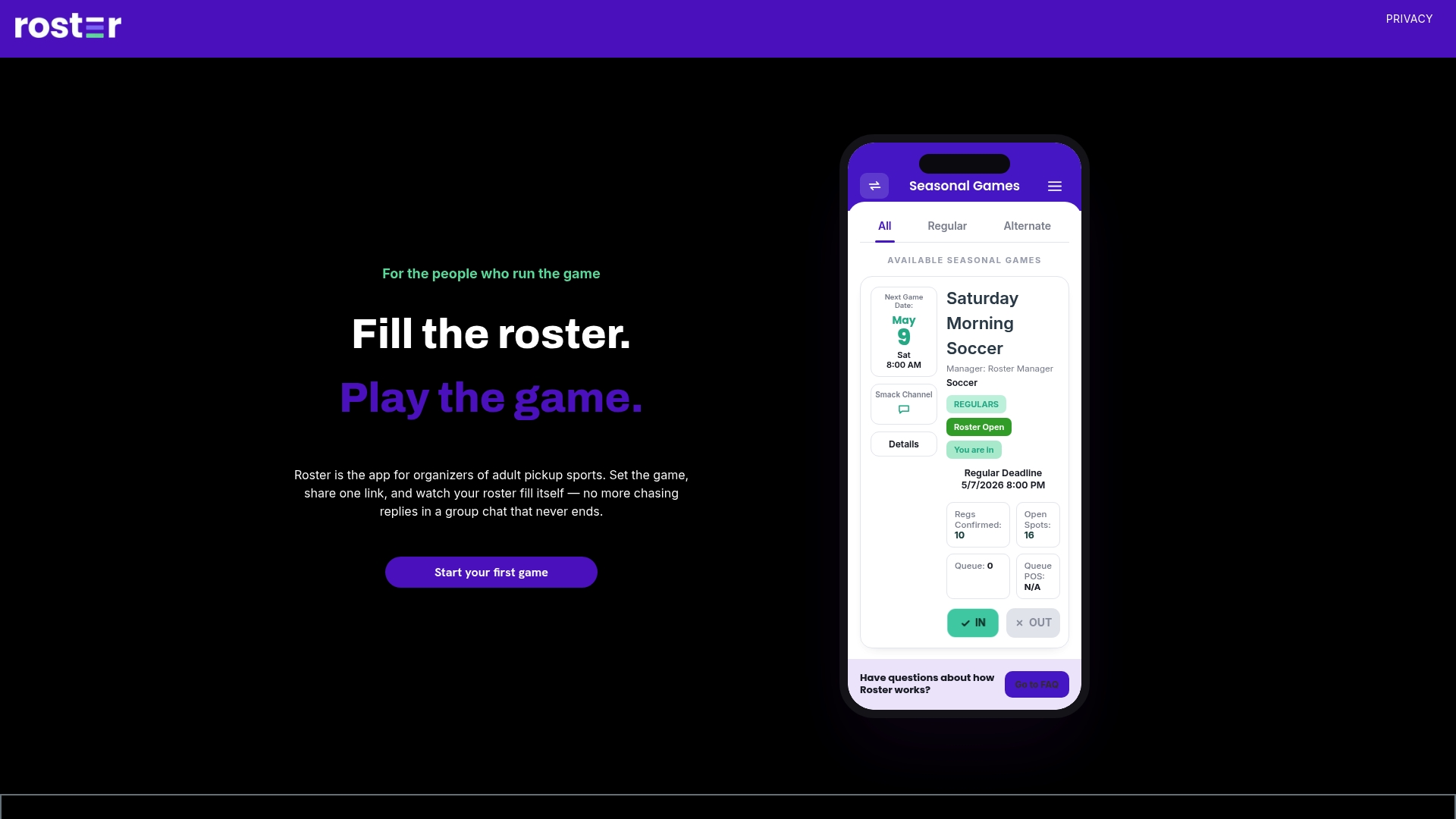
Whichever fee model you choose, the work is the same: get players to commit, keep the roster full, and keep track of who is in. Roster lets you set the game details, share one link and let players sign up, with open spots filled in real time and a waitlist ready when someone drops. Regulars and alternates are handled separately, which matches the hybrid model above.
See how Roster works for your next game and take the RSVP-chasing off your plate.
FAQ
Is it cheaper to pay for the season or drop in?
If you play most weeks, the season is almost always cheaper per game. Published rates show how it works: one soccer facility charges $20 for a single pickup session but $40 a month for unlimited pickup. Drop-in is cheaper only if you will play just a game or two.
Should I charge per player or one fee per team?
For casual pickup, per player is simpler because nobody fronts the money and you collect directly from everyone. Team fees suit structured leagues where a captain manages the group. Some leagues allow both: the captain pays it all or splits it so each player pays their share.
How much should alternates pay compared with regulars?
Set the alternate price a bit above what regulars effectively pay per game. That keeps the season attractive while giving substitutes a fair, predictable rate. Whatever you choose, state it before the season so there are no surprises.
What if a regular quits halfway through the season?
Decide this before you collect money. Common options are a prorated credit, handing the spot to someone on the waitlist, or no refund with a clear explanation. A written rule, even one sentence in the signup message, avoids most arguments.
Sources
- Adult Futsal League, The Forge Sports Center
- Adult Pickup Soccer, TOCA
- Recreational Adult Soccer League, TOCA
- Volo Pass, unlimited sports and social games
- Membership plans, Interior Pickup Association
- Adult leagues, Futsal Underground
- Frequently asked questions, Underdog Sports Leagues Seattle
- Adult sports, Longevity Sports Center
- Team and fee info, Nashville Sports Leagues
- Leagues FAQ, KCCrew