November 4, 2026
How to Collect Game Fees From Players Without Chasing Anyone


The simplest way to collect game fees is to make payment part of the signup, so a player's spot, their money and your roster live in one place. Set the price before you announce the game, send one link, and confirm each player's payment against your records rather than against memory or a group chat scroll. This guide covers how to do that for season dues and for drop-in players, which payment methods hold up, what a payment record should include, and how to handle the awkward cases.
TL;DR
- Tie payment to the spot: a player is on the roster when they have signed up and paid, not when they said "I'm in" in a text.
- Use one payment method you can verify, and keep money out of mixed personal accounts where you can.
- Record name, amount, date, method, what the fee covered and any balance. That is your whole tracker.
- Charge drop-in players per game, with a clear cutoff and a waitlist so an open spot gets filled.
- Send reminders automatically and share a simple cost breakdown so nobody wonders where the money goes.
Table of Contents
- Why collecting fees turns into a chore
- Start with the price, not the payment app
- Season dues versus drop-in fees
- Choosing how players pay
- What a payment tracker should record
- Following up without being the bad guy
- A simple setup you can run this week
- Where Roster fits
- FAQ
- Sources
Why collecting fees turns into a chore
Most organizers of adult pickup games do not start out wanting to be a collections department. You rent a field or gym, you need ten to twenty people to show up, and somebody has to cover the cost. The trouble starts when RSVPs, payments and replacements all live in different places: a group chat for "who's in," Venmo notifications for money, and a notes app for the rest.
Three problems show up again and again:
- You can't tell who paid. A payment arrives with the memo "soccer" or a pizza emoji, from a name that doesn't match the person on your list.
- Dropouts leave you short. A player cancels the night before, you have already committed to the field, and nobody knows whether they owe you.
- The awkward ask. Reminding adult friends about money feels worse than it should, so you either do it publicly and stiffly or you quietly cover the gap yourself.
Every fix below is aimed at one of those three problems. None of them needs a complicated system. They need a consistent one.
Start with the price, not the payment app
Before choosing how to collect, decide what you are collecting. A fee that players understand gets paid faster, and one that feels arbitrary gets questioned in the chat.
Add up the real costs for the period you are charging for:
- Field, turf or court rental per game or per season
- Referee or league fees, if any
- Equipment such as balls, pinnies and cones
- A small buffer for no-shows and weather cancellations
Divide by the number of players you expect to roster, not the number you hope for. If you need a worked example, our breakdown of how to split field costs fairly for pickup games walks through the math, and the pickup soccer cost example using an $85-an-hour turf rental shows how the per-player number changes with group size.
Two habits keep pricing painless. First, publish the number and what it covers in the same message as the game details. Second, charge the same way every time. A player who learns that the fee is always due at signup stops treating it as a negotiation.
Season dues versus drop-in fees
There are two different jobs here, and they deserve different rules.
Season dues for regulars
If you run a standing weekly game or a short season, collect once, up front, from a set group of regulars. The advantages are large: you know your numbers before the first kickoff, you can book the field with confidence, and you are not asking for money every week.
A structure that works:
- Set the dues amount and a signup deadline.
- Set a separate full-payment deadline if you allow installments.
- Decide in advance what happens after the deadline, and say it in the signup message.
Organized leagues already work this way. One community soccer league's published rules, for example, describe setting an amount with signup and full-payment deadlines, letting teammates or the captain pay online, and charging unpaid balances to the captain's card after each deadline. The same rules note that dues that can't be collected can lead to forfeits or cancelled games. You don't need league-level enforcement for a casual game, but the lesson carries over: a clear deadline and a clear consequence, stated before anyone pays, prevent most disputes.
Drop-in fees for individual games
Drop-in players are the harder case, because the commitment is small and the attention span is short. A few rules make them manageable:
- Charge per game, at signup. If a player has to pay to claim the spot, you stop holding spaces for people who "might" come.
- Set a cancellation cutoff. Say plainly, for example, that a player who drops before a certain time frees the spot and is not charged, while a later dropout is. Pick your own window and keep it consistent.
- Keep a waitlist. When someone drops, the next person in line takes the spot. This protects your field cost and gives eager players a real shot at playing.
- Price drop-ins slightly above the season rate. Regulars who commit up front should feel rewarded. This is a pricing choice that is yours to make, not a rule.
The point is that the spot and the money move together. If someone gives up the spot, the roster and the balance update at the same time instead of in two separate conversations.
Choosing how players pay
There is no single best method. There is the method you can verify, reconcile and explain.
| Method | What works | What to watch |
|---|---|---|
| Cash | Zero setup, instant | No record. Disputes about who paid are unresolvable, and you have to carry and deposit it. |
| Peer-to-peer apps (Venmo, Zelle, Cash App) | Players already have them; fast | Payments don't connect to a roster, so you match names and memos by hand. |
| Card payment through a sign-up tool | Payment attached to the player's record | Card processors charge a percentage plus a fixed fee per payment, so decide who absorbs it. |
| Bank transfer or check | Low fees | Slow, and easy to lose track of. |
If your group mostly uses Venmo, that is fine. Our guides on how to track Venmo payments from players and how to verify player payments in under a minute cover the matching problem in detail. The short version is to require a consistent memo format and to check each incoming payment against a list that already has the player's name on it.
Precautions that matter
Pay attention to scams. The Consumer Financial Protection Bureau's guidance on mobile payment apps warns that a payer can appear to send money and then cancel it, and that these services are safest with people you know and trust. For a pickup game, that mostly argues for confirming the payment actually landed before you mark someone paid, especially for anyone you haven't met.
Know what verification your app asks of you. If you collect enough that you set up a business profile, Venmo's help center explains that it verifies identity information: business name, address and EIN for a business profile, or personal details for a profile tied to an SSN or ITIN. Expect to be asked for it, and read the current rules on the help page before you set one up.
Keep your own money separate. Funnelling a season of player money through your personal account makes your own records messy and invites questions. If you are collecting for a group over a long season, open a separate account or at least a separate payment profile so the group's money is visible on its own.
Think about taxes if volume grows. For most casual organizers this never comes up. If you do take larger volumes through a payment platform, the IRS explains that third-party settlement organizations must report payments on Form 1099-K when they exceed $20,000 and 200 transactions under its 2026 guidance. If you are collecting near those levels, or you aren't sure whether your game counts as a business, ask a CPA or enrolled agent rather than guessing.

What a payment tracker should record
You do not need accounting software for a weekly game. You need a list that answers one question in a few seconds: has this person paid for this thing?
For each player, record:
- Full name, as it appears on their payment account
- Amount paid
- Date paid
- Payment method
- What the fee covered (season dues, a single game, a jersey)
- Any remaining balance
That last column does the work. When a player pays half, or pays for one game and promises the next, a visible balance replaces a vague "I think he owes me something."
A few habits make the record trustworthy:
- Update it the moment money lands. A tracker you fix on Sunday night is a tracker with errors.
- Keep the history. Don't overwrite last season's list. If someone claims they paid in March, you can check.
- Share the totals, not the individuals. A quick note such as "we collected this much and spent this much on field rental" reassures everyone without publicly shaming anyone.
A spreadsheet handles this for one group. It starts to strain when you run several teams or nights, which is when a tool that ties signups to payments earns its place. Our post on multi-team scheduling for rec leagues covers that stage.
Following up without being the bad guy
The fastest way to stop awkward reminders is to make them automatic and impersonal.
- State the rule once, at signup. "Your spot is held when payment is received." Nobody can say they weren't told.
- Send a reminder before the deadline, not after. A nudge that arrives while the spot is still open feels like help rather than pressure.
- Make the consequence mechanical. If the deadline passes and the spot isn't paid for, it goes to the next waitlisted player. You aren't punishing anyone; the system moved on.
- Keep individual follow-ups private. A direct message to one person is fine. A group-chat callout is how friendly games turn sour.
- Don't absorb the shortfall quietly. Covering one missing payment is generosity. Covering it every week is a second job you didn't apply for.
For cashless games in particular, a single link that handles signup, payment and the waitlist removes most of this. We describe that setup in one signup link for cashless pickup games.
A simple setup you can run this week
Here is a plain workflow for a weekly pickup game of about sixteen players:
- Work out your per-player cost from the field rental and add a small buffer.
- Decide your season rate for regulars and your per-game rate for alternates.
- Write the game details, the price and the cancellation cutoff into one message.
- Send a single signup link instead of asking for replies in the chat.
- Mark each player paid only after the money has arrived.
- Let the waitlist fill any dropouts, and update balances the same day.
- Share a short cost summary at the end of the season.
That is about an hour of setup for a season of games, and most of it is the first step.
Our view: the money problem is really a roster problem
We built Roster for people who run adult pickup games, and what we hear from organizers is rarely "I need a payment processor." It is "I can't tell who is actually coming, and I'm tired of asking."
That is why we think fees should be handled in the same place as the roster. When a spot, a payment and a waitlist are separate things, you become the glue between them. When they are one thing, a dropout opens a spot, the next player takes it, and nobody has to negotiate in a group chat.
Our approach is designed around that idea: you set the game details, share a single link, and the app manages regulars, alternates and the waitlist in real time. Managers are billed on rostered participation, and players deal only with their manager for any money they owe. The goal is simple: spend less time administering the game and more time playing it, with fewer screens in the way.
Daniel
Where Roster fits
If you are tired of piecing this together from a chat, a payment app and a spreadsheet, Roster is built for exactly this job. You set the game, share one link, and the app tracks signups, rostered regulars and alternates, open spots and the waitlist as players join or drop. It also supports group chat and peer-to-peer Venmo payment tracking between players and managers, so you can see who has paid without hunting through notifications.
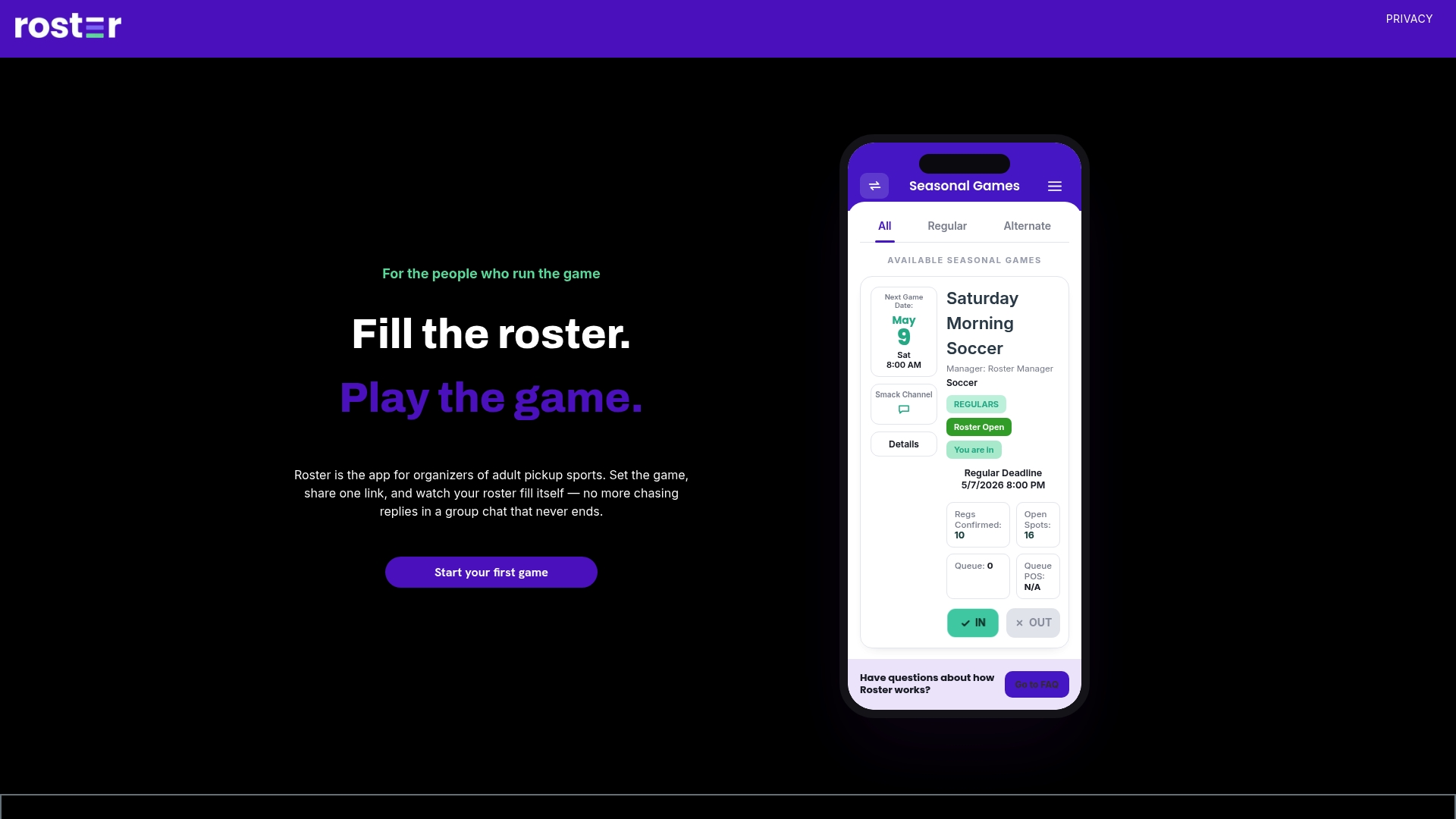
Managers are billed to the card on file based on rostered participation, and players do not pay Roster. Try it on your next game and see how much of the admin disappears.
FAQ
How do I collect game fees from players who only show up occasionally?
Charge per game at the moment they claim a spot, and set a clear cancellation cutoff. A paid spot is a real commitment, and a waitlist lets you refill it if they drop. Price alternates a bit above the season rate so regulars who commit early come out ahead.
What is the easiest way to track who paid?
Keep one list with each player's name, amount, date, method, what the fee covered and any balance, and update it as money arrives. If players pay through a peer-to-peer app, require a consistent memo and match every payment to the list before marking it paid. A tool that connects signups to payments saves you the matching.
Is Venmo safe for collecting team fees?
It is widely used and fine among people you know, but confirm that each payment has actually completed before you mark it paid. The CFPB notes that scams can involve a payer who sends money and then cancels it, and that these services are safest with people you trust. Keep group money separate from your personal spending.
Do I owe taxes on money I collect from my team?
It depends on how much you collect and how you collect it, and a casual game that only splits costs is a different situation from a business. The IRS sets reporting thresholds for payment platforms, including $20,000 and 200 transactions for Form 1099-K under its 2026 guidance. If you are unsure, ask a CPA or enrolled agent.
What should I do when someone doesn't pay?
Follow your stated rule rather than improvising. Send a private reminder before the deadline, then release the spot to the next person on the waitlist if payment doesn't arrive. Keep the conversation one-on-one and leave the group chat out of it.
Sources
- League Rules, Soccer KC
- Helpful tips for using mobile payment services and avoiding risky mistakes, Consumer Financial Protection Bureau
- Business Profile Identity Verification FAQ, Venmo Help Center
- A Guide to Information Returns, Internal Revenue Service