September 29, 2026
Copy Ready Alternate Player Policy for Youth and Amateur Organizers


An alternate player policy defines who can fill in for a rostered player, under what conditions, and with what paperwork. Every workable policy needs three non-negotiables: clear eligibility rules, a roster freeze date, and required documentation such as loan or club-pass forms. Local league rules never override a state or national governing body's deadlines, and organizers who ignore that hierarchy risk forfeits.
TL;DR:
- Alternates must meet the same age and registration criteria as full roster players, and their eligibility is confirmed by paperwork before roster freeze deadlines.
- Roster construction should specify maximum sizes, freeze dates, and approval processes, with credential checks at check-in to prevent ineligible players from participating.
- Tournament deadlines are strict, often requiring forms and permissions filed before the roster freeze, with penalties including disqualification or forfeiture for violations.
- Utilization of an alternate program demands clear communication, tracking of minimum play requirements, and formalized agreements to prevent roster cloning and no-shows.
- Automated roster management systems can streamline signing, waitlisting, and billing processes, reducing manual tracking and ensuring compliance across the season and tournaments.
Table of Contents
- Defining Alternate, Guest, and Club Pass Players
- When Alternates Are Allowed
- Building a Compliant Roster From the Start
- Eligibility Rules and In-Game Substitution Procedures
- Managing Alternates Through the Season
- Tournament Deadlines and the Cost of Missing Them
- A Copy-Ready Alternate Player Policy Template
- What Organizers Get Wrong About Alternate Programs
- Where Roster Fits Into Your Alternate Workflow
- Sources
- FAQ
Defining Alternate, Guest, and Club Pass Players
The terms get used loosely, and that looseness causes forfeits. An alternate player is someone formally attached to a team roster for part of a season, often at a reduced fee, to fill gaps when regulars are unavailable. A guest player is typically a short-term addition for a single tournament, brought in with permission from their home club. A club pass or loan player moves temporarily from one team to another within the same organization, usually requiring written approval from both coaches and the registrar.

Scope matters just as much as terminology. A league roster covers a full season and usually locks after a set freeze date, while a tournament or event roster is a separate document, often stricter, that must be submitted before the event's own deadline. A player can be legal on a league roster and still be ineligible for a specific tournament if the event's paperwork was never filed.
Common restrictions organizers should write into their bylaws:
- A player may be rostered on only one team per age division at a time.
- Guest and loan players must meet the same age eligibility as the team they join.
- Double-rostering across two teams in the same tournament is generally prohibited unless the event manual explicitly allows it.
When Alternates Are Allowed
Most leagues allow alternates more freely during the regular season than during tournament play, where sanctioning bodies tend to tighten the rules. A weekly rec league might let a coach add a substitute the morning of a game with a text to the league office. A tournament, by contrast, usually locks its roster well in advance and treats any late addition as a formal exception requiring written approval.
Emergency situations, such as a season-ending injury or a family relocation, are the most common reason organizers grant a roster exception mid-season. A defensible process documents the request in writing, gets sign-off from a board member or rostering committee, and keeps a copy on file in case the change is questioned later.
Typical allowances and restrictions organizers should set:
- Regular-season games: alternates can often be added with short notice and a simple approval email.
- Tournament and playoff games: rosters usually freeze weeks ahead, and additions require formal exception requests.
- Sanctioning bodies and tournament directors can impose stricter rules than the home league, and those rules govern at the event.
Building a Compliant Roster From the Start
Roster construction is where most disputes start, because it happens weeks before anyone notices a problem. Getting it right up front avoids a credential-check scramble later.
- Set a maximum roster size and state clearly whether alternates count against that cap or sit in a separate pool.
- Publish a roster freeze date well before the season or event begins, and spell out the process (and any fee) for late changes after that date.
- Verify credentials at check-in, including birth certificates or registration proof, and require loan or transfer forms for any player not on the original roster.
- Route every addition through board or committee approval, with a written record rather than a verbal yes from a single coach.
Tournament organizers face an added layer here: state and national guidance routinely requires that only players on the roster by the freeze date are eligible, and credential checks at tournament check-in confirm that paperwork before a single game is played. Even when a governing body has technically approved a roster, the responsibility for verifying each player's eligibility stays with the team.
Eligibility Rules and In-Game Substitution Procedures
An eligibility policy only works if it is specific enough to survive a protest. Vague language like "coach's discretion" invites disputes at the worst possible moment, mid-tournament, with a game on the line.
- Every player, including alternates, must be properly registered with the governing organization before stepping on the field or ice.
- Loan, club-pass, or transfer forms must be completed and, where required, countersigned by both clubs before the player is eligible.
- Substitutions during a game should follow the sport's own protocol: notify the referee or official scorer, and where return substitutions are allowed for youth play, note any limit on how many times a player can re-enter.
- Playing up or down an age division usually requires separate written permission and does not automatically extend to tournament rosters.
- Double-rostering the same player on two teams in one event is grounds for disqualification in most tournament manuals.
The consequences for skipping any of this are consistent across governing bodies: using an unrostered or improperly documented player can trigger forfeiture or loss of tournament bids, regardless of how good the intentions were.
Managing Alternates Through the Season
An alternate program works best when it is treated as a real roster status, not an informal favor. That means setting expectations up front and tracking them consistently.
- Ask alternates to commit to a minimum number of practices per month so they stay game-ready.
- Set a play-percentage target, commonly around 60% of regular-season games, for playoff eligibility, similar to the thresholds some hockey programs use.
- Charge alternates a reduced fee rather than the full season rate, and bill it only for games actually played.
- Keep a simple log of games dressed per alternate so playoff eligibility disputes have a paper trail.
Pro Tip: Publish a weekly availability board so alternates can see open slots before a coach has to chase them down by text.
Clubs that formalize this process often build it into a signed alternate agreement that spells out the reduced fee, practice expectations, and the games-played threshold needed to qualify for playoffs or convert to a full roster spot. Related tactics for keeping games full and reducing last-minute gaps are covered in reducing no-shows in pickup games.
Tournament Deadlines and the Cost of Missing Them
Tournament rules tend to be far less forgiving than league rules, and the deadlines are usually published months in advance. Some youth soccer events allow up to six guest players per roster, but only when loan forms and inter-club permissions are filed before the roster freeze. Miss that window and the guest slot disappears, no matter how good the reason.
Hockey programs face some of the strictest deadlines in youth sports: national-bound Tier I and Tier II teams are often barred from adding players after December 31, with some high-school national-bound teams facing a February 15 cutoff instead. There is no season-long grace period once those dates pass.
- Confirm the exact freeze date in the tournament manual, not just the general league calendar.
- Submit loan, club-pass, or transfer forms before the deadline, with copies retained in an event folder.
- Expect penalties ranging from forfeiture to disqualification or loss of future tournament bids for ineligible participants.
- Build an emergency substitution process for injuries during the event itself, since most manuals allow same-day medical replacements even after the roster freeze.
A Copy-Ready Alternate Player Policy Template
Adapt the language below directly into your bylaws or event handbook.
Policy purpose: This policy defines alternate and guest player eligibility, roster procedures, and documentation requirements for [league/team name]. An alternate is a player rostered at reduced commitment to fill gaps caused by injury, absence, or scheduling conflicts.
- Eligibility: Alternates must meet the same age and registration requirements as full roster members.
- Roster construction: Maximum roster size is set at the start of the season; alternates occupy a separate pool that does not count against the primary roster cap.
- Freeze dates: The roster freezes [X weeks] before the season opener and again before any postseason or tournament play.
- Documentation: All loan, club-pass, or transfer forms must be filed with the registrar before the freeze date; original registration proof is required at any credential check.
- Fees: Alternates pay a reduced rate, billed only for games in which they participate.
- Dispute resolution: Roster disputes go to a rostering committee within 48 hours of the game in question.
Game-distribution guidance: alternates should be scheduled across multiple games rather than clustered in one stretch, and a simple spreadsheet tracking games dressed per alternate resolves most playoff-eligibility questions before they become disputes.
Pre-event compliance checklist:
- Roster freeze date confirmed and published.
- Loan and club-pass forms filed for every guest or alternate.
- Credential documents copied and stored in the event folder.
- Board or committee sign-off recorded for any late roster addition.
What Organizers Get Wrong About Alternate Programs
The most common mistake is roster cloning, listing the same strong alternate on two teams and hoping nobody checks. It works until a tournament credential check catches it, and then the penalty falls on the whole team, not just the player. The second mistake is silence: alternates who don't know their play-percentage target or fee structure quietly stop showing up.
A managed alternate program, with clear communication and a predictable path to more playing time, keeps alternates engaged and reduces no-shows. Some of that comes down to basic team communication practices that apply to any roster, not just alternates.
— Daniel
Where Roster Fits Into Your Alternate Workflow
Writing the policy is one job. Enforcing it every week, tracking who played, billing the right amount, and keeping a waitlist ready when someone drops out, is another. Roster automates the parts of that job that eat an organizer's evening: it fills open roster spots in real time, manages a waitlist for dropouts, and tracks per-alternate participation so you're not reconstructing a season from group chat screenshots.
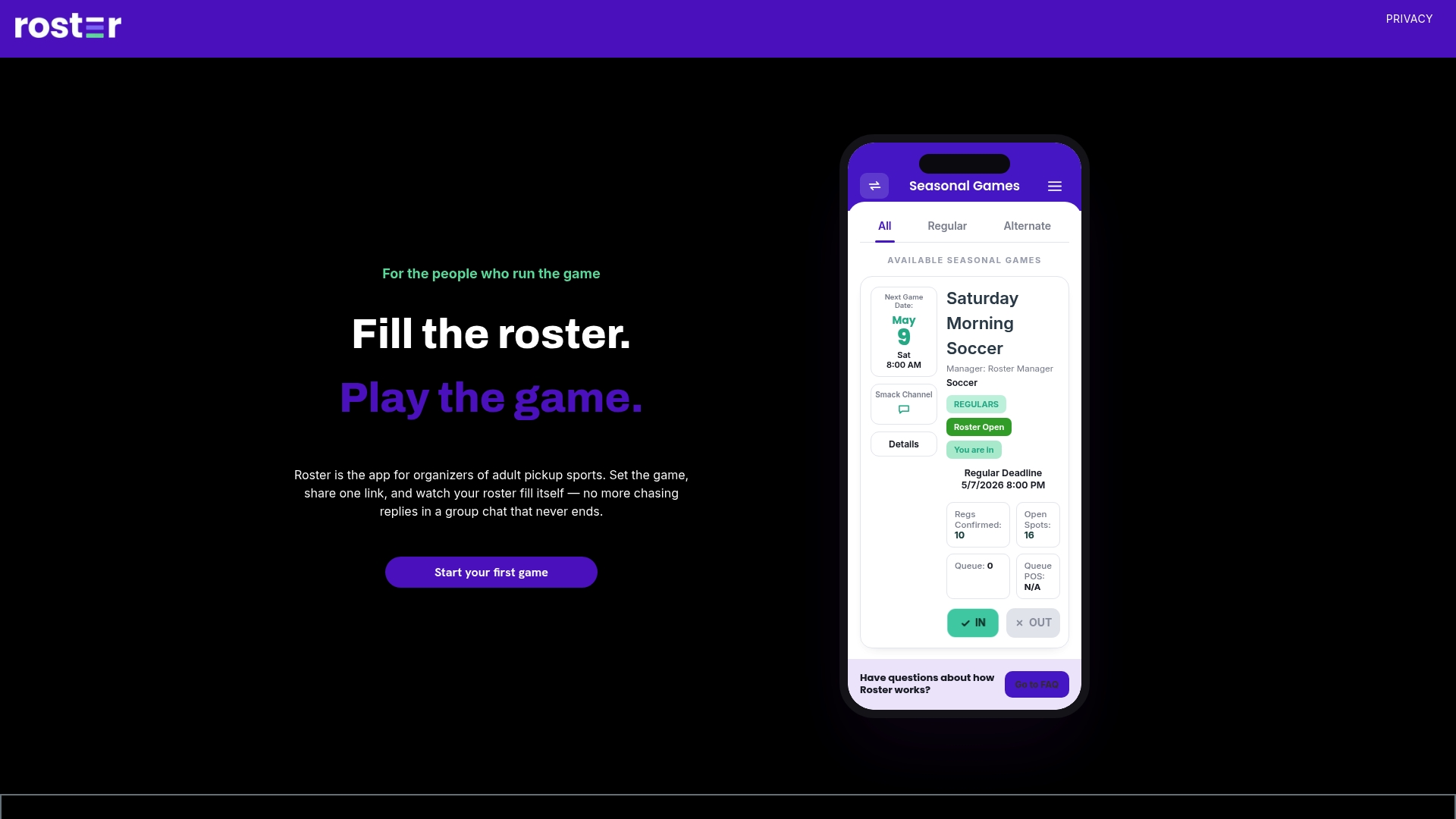
Billing follows the same logic as the policy above: alternates are charged per game played, not a flat season rate. If your league or tournament team is ready to stop tracking rosters by hand, see how Roster handles signups, waitlists, and alternate billing in one link.
Sources
Save PDF copies of your governing body's current rules before every season and every event: USA CUP's qualifier rules, USA Hockey's technical bulletin, and any state association's roster-submission guidance. Credential checks move fast at tournament tables, and a saved copy settles disputes on the spot.
- USA CUP Qualifier rules (2026)
- USA Hockey technical bulletin and registry guidance
- Masconomet Youth Hockey alternate player policy (example)
FAQ
What does "alternative player" mean?
An alternate (sometimes called an alternative) player is someone formally attached to a roster at reduced commitment, brought in to fill gaps from injury, absence, or scheduling conflicts. They typically pay a reduced fee and must meet the same registration and age eligibility as full roster members.
Can a guest player play in more than one tournament?
It depends on the event and the governing body's rules, since some tournaments allow guest players with loan forms filed before the roster freeze while others restrict guests to a single event. Always check the specific tournament manual rather than assuming league rules carry over.
What happens if a team uses an unrostered player?
Using an unregistered or improperly documented player can lead to forfeiture or loss of tournament bids, even if the mistake was unintentional. Most governing bodies place the verification responsibility on the team, not just the tournament office.
How many games does an alternate need to play for playoff eligibility?
Requirements vary by league, but a common benchmark is around 60% of regular-season games or a set practice-attendance minimum. Organizers should track games dressed for each alternate throughout the season to avoid disputes right before playoffs.
Does Roster help manage alternate players?
Roster tracks alternate signups, fills open spots from a waitlist, and bills per-alternate participation automatically, which removes the manual spreadsheet work most organizers rely on. Details on the app's features are available on the Roster site.