October 14, 2026
Pickup Game Insurance: Get the COI Ready Before Game Day


Most pickup games on rented fields or public parks need some form of liability coverage, especially once spectators, paid admission, or alcohol enter the picture. The fastest fixes are a single-event liability policy or an existing team program, plus a quick check of your homeowner or renter policy for gaps. Before anyone takes the field, get a certificate of insurance naming the venue as additional insured.
TL;DR:
- General liability covers third party injuries when organizers are at fault; accident coverage addresses players' medical costs, and alcohol can require liquor liability.
- Ask the venue for limits first, then request a certificate naming it as additional insured, with correct dates, at least a week before kickoff.
- After an incident, record who was involved, witnesses, time, and location, photograph relevant hazards, and notify the insurer promptly within its reporting window.
Table of Contents
- Where to Buy Coverage for a Pickup Game
- Matching Coverage Types to Your Actual Risks
- Getting the Venue to Accept Your Proof of Coverage
- What Pickup Game Insurance Actually Costs
- Keeping Records That Make Insurance Easier to Use
- Filing a Claim After an Incident on the Field
- State and Local Insurance Rules for Pickup Sports
- Lowering Your Premium Through Safety and Waivers
- Coverage Shouldn't Be the Reason People Stop Playing
- Roster Handles the Admin So You Can Focus on the Game
- FAQ
- Sources
Where to Buy Coverage for a Pickup Game
Organizers generally pick between two paths: a single-event policy bought just for one game, or an ongoing team or league program that covers a full season. The right choice depends on how often you play and whether you already belong to a chartered club.
Chartered amateur youth leagues typically qualify for Little League® group insurance, a negotiated program that bundles general liability with accident medical options and higher aggregate limits than a one-off policy usually offers, according to Little League's insurance overview. Tournament teams and adult leagues that want flexibility often look at Perfect Game / American Specialty team insurance, which sells both single-event and annual options with per-player pricing and per-occurrence limits commonly set at $1,000,000, based on the 2025 Perfect Game team insurance brochure. For teams or associations that want to quote and bind coverage online without a broker call, K&K amateur sports programs offer instant quoting and immediate proof of coverage. Clubs that want a packaged program with risk-management support, not just a policy, tend to look at the Golden (Corgi) sports vertical, which bundles coverage with program-level services like safety training tie-ins.
| Program | Best for | Sample limit | Policy term | How to buy / COI |
|---|---|---|---|---|
| Little League® group insurance | Chartered youth leagues | Program-negotiated limits | Seasonal, charter-based | Through league charter process |
| Perfect Game / American Specialty | Tournament teams wanting flexibility | $1,000,000 per occurrence | Single-event or annual | Online application, documented pricing |
| K&K amateur sports programs | Adult/youth teams wanting fast quotes | Varies by sport and roster | Single-event or annual | Instant online quote and COI |
| Golden (Corgi) sports vertical | Clubs wanting bundled risk management | Varies by program | Annual program | Broker-assisted application |
For a game happening next week, a single-event policy through a specialty provider is usually the quickest route since some single-event policies can be issued the same day. For a recurring weekly run, joining or starting an annual team program tends to cost less over a season than buying repeat single-event policies.
Matching Coverage Types to Your Actual Risks
Buying the wrong type of policy is the most common mistake organizers make. Each exposure on a pickup field maps to a specific coverage, and knowing the difference keeps you from paying for protection you don't need or missing the protection you do.
- General liability covers claims when your organization is at fault for injury to a spectator or damage to the venue, such as a fan tripping on uneven ground near the sideline.
- Participant accident/medical pays medical costs for players hurt during play regardless of fault, which matters because general liability alone often won't cover a player's own sprained ankle.
- Property/inland marine covers equipment you own or rent, like portable goals or a sound system, if it's damaged or stolen.
- Liquor liability applies if alcohol is served or allowed at your event and someone is hurt as a result.
- Event cancellation reimburses costs if a covered reason forces you to postpone or cancel, a coverage built for larger-budget events rather than casual weekly runs.
A $1,000,000 per-occurrence limit is a common minimum across team and event programs, including Perfect Game's documented limits, and organizers who want more cushion often add umbrella coverage in $1,000,000 increments on top of a base policy.
Getting the Venue to Accept Your Proof of Coverage
Most venues won't let you book a field or permit without seeing a certificate of insurance, and many require you to name them as additional insured. The process is straightforward if you follow it in order.
- Ask the venue directly what limits and endorsements they require before you shop for a policy.
- Request a certificate of insurance that names the venue as additional insured, not just a generic COI.
- Confirm the policy dates cover your actual game date and that the limits match what the venue asked for.
- Verify the insurer's license through your state's Department of Insurance website rather than taking the COI at face value, since NAIC warns that fraudulent certificates and unlicensed intermediaries are a documented risk.
- Request a formal endorsement if the venue wants proof beyond a standard certificate.
Single-event policies can sometimes be issued the same day, while annual programs typically take longer to underwrite and bind.
Pro Tip: Request your certificate of insurance at least a week before game day so you have time to fix any naming or date errors before the venue rejects it.
What Pickup Game Insurance Actually Costs
Single-event liability policies tend to run as small flat fees for a single afternoon of play, while annual team or league programs price by roster size, sport, and frequency of games. Event cancellation coverage, when it applies to larger tournaments, commonly runs about 1 to 1.5% of the total event budget, according to Triple-I's reporting on event cancellation pricing, though casual pickup games rarely need this coverage at all.
Several factors push premiums up or down:
- Number of participants on the roster and whether the game is open pickup or a closed, rostered group.
- Alcohol service or paid admission, both of which raise the liability profile significantly.
- Field surface and duration, since turf, concrete, or uneven ground changes injury risk.
- Prior claims history for the organizer or league.
Cost-saving moves include choosing a single-event policy for occasional games instead of an annual program, joining a group program once games become regular, and raising your deductible or narrowing coverage scope to match your actual exposure. A homeowner or renter umbrella policy adds roughly $200 to $350 per $1,000,000 of extra liability, per the Insurance Information Institute, which is worth checking before assuming you need a standalone event policy.
Keeping Records That Make Insurance Easier to Use
Coverage only helps if you can prove who was playing, who signed a waiver, and what the venue agreed to. Good recordkeeping turns a potential dispute into a five-minute conversation with your insurer.
- Collect a signed waiver from every player before their first game, tied to the specific signup rather than a general form (see our waiver guidance for pickup organizers).
- Track rostered players separately from alternates, and keep payment records so you can produce an accurate attendance list if an incident happens.
- Store your certificate of insurance and any endorsements alongside your game records, so a venue or insurer request doesn't send you digging through old emails.
Organizers running weekly pickup soccer or similar recurring sessions find that a simple, consistent system matters more than any single policy feature.
Filing a Claim After an Incident on the Field
Start by documenting the incident while details are fresh: who was involved, what happened, the time and location, and the names of any witnesses. Take photos of the field, equipment, or surface condition if that contributed to the injury or damage.

Notify your insurer as soon as possible after the incident, since most policies set a reporting window and delays can complicate a claim. Provide your roster records, the signed waiver for the injured player, and the certificate of insurance for the venue if the claim involves a property dispute.
Cooperate with the insurer's adjuster and avoid admitting fault or offering a settlement yourself, since that's the carrier's job once a claim is open. Keep a copy of every document you submit, and follow up in writing rather than relying only on phone calls. A clear paper trail, built from the waiver and attendance records you already keep, is usually what moves a claim along quickly rather than stalling it.
State and Local Insurance Rules for Pickup Sports
There's no single federal law requiring pickup sports organizers to carry insurance, but requirements show up at the venue and municipal level instead. Public parks departments and school districts commonly require a certificate of insurance with specific limits before issuing a field permit, regardless of what state you're in.
Some municipalities also require liquor liability coverage if alcohol will be present at a permitted event, separate from the general liability requirement. Private venues set their own rules too, and those can be stricter than anything a city requires.
Because requirements vary by venue and locality rather than by a uniform statute, the practical approach is to ask the specific field, park, or facility what they require before assuming a state-level rule applies. Verifying that your insurer or broker is licensed in your state through the state Department of Insurance protects you regardless of which local rule applies, since it confirms the coverage itself is legitimate.
Lowering Your Premium Through Safety and Waivers
Underwriters price risk based on what you can show them, not just what you tell them. Demonstrating supervised play, consistent rosters, and basic safety checks can ease pricing pressure even on a modest pickup budget.
Require a signed waiver from every participant before they play, and keep those records organized by game rather than scattered across emails or paper forms. Conduct a quick field inspection before games, checking for holes, loose goals, or debris, and note that you did it.
Basic protective gear matters too: for any contact sport, encouraging players to wear a properly fitted mouthguard is a simple step that reduces injury risk without adding real cost to your event. Limiting alcohol service, capping spectator access, and keeping your roster closed rather than fully open to drop-ins also reduce the exposure an underwriter is pricing against. None of these guarantee a lower quote, but a visible safety record gives you more to negotiate with when you renew.

Coverage Shouldn't Be the Reason People Stop Playing
The instinct to either skip insurance entirely or over-buy a policy built for a stadium event both miss the point. Most pickup organizers need a modest, targeted policy and a habit of keeping good records, not a complicated program designed for professional leagues.
The groups that handle this well treat the paperwork as routine: a waiver on file, a roster that matches who actually showed up, a COI saved where they can find it. That discipline protects you more than any extra coverage layer, and it's the part most organizers skip until something goes wrong.
— Daniel
Roster Handles the Admin So You Can Focus on the Game
Coverage protects you once something goes wrong, but most of what actually prevents disputes happens before kickoff: knowing who's on the roster, who signed a waiver, and who paid. We built Roster to automate exactly that layer for adult pickup organizers.
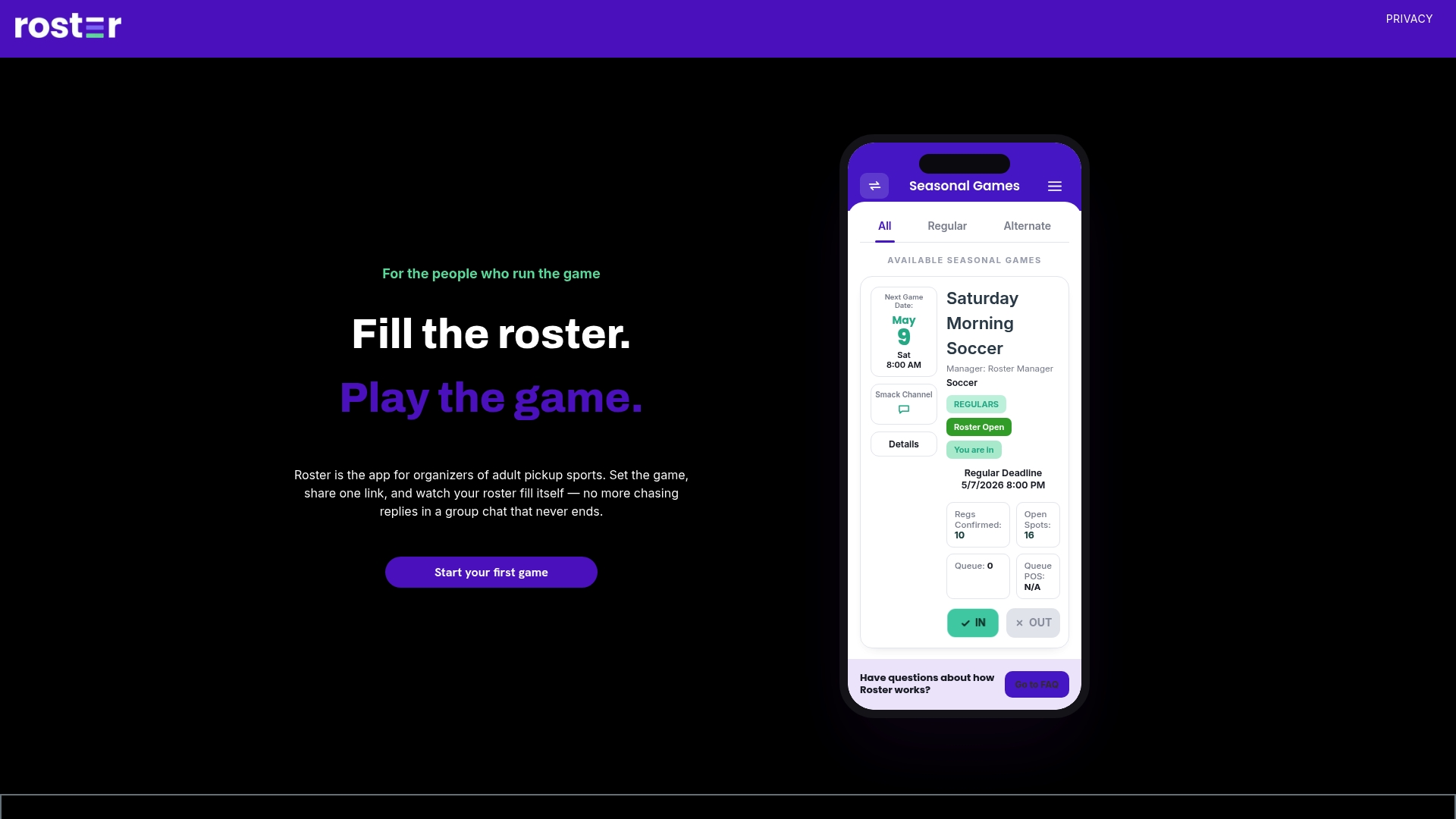
With our app, you share one link for signups instead of chasing RSVPs across group chats, and open spots fill automatically while keeping a waitlist for dropouts. Here's what that means for your insurance paperwork:
- A real-time roster shows exactly who played on a given date, which is what an insurer or venue asks for first after an incident.
- Payment tracking through Venmo keeps a clear record of who paid for which game, supporting your attendance history.
- Pairing the signup flow with a signed waiver process means you have documentation ready before a certificate of insurance is ever requested.
See how the app's features fit into your weekly game, and spend your time on the field instead of in your inbox.
FAQ
Do I really need insurance for a casual pickup game?
If you're renting a field, hosting spectators, or your homeowner policy wouldn't cover an organized event, you generally need a dedicated liability or participant policy. Checking your homeowner or renter policy for gaps first can save you from buying duplicate coverage.
How much does sports liability insurance typically cost?
Single-event policies are often priced as small flat fees, while annual team programs price by roster size and activity level, and specific per-player figures appear in programs like the Perfect Game brochure. Adding umbrella coverage on top of a homeowner policy typically costs several hundred dollars per million dollars of extra liability.
What's a certificate of insurance and why does a venue want one?
A certificate of insurance (COI) is proof that a policy exists, and venues ask for one naming them as additional insured so they're protected if a claim arises from your event, per NAIC's guidance on event insurance. Always verify the issuing insurer is licensed in your state before relying on the certificate.
How quickly can I get coverage before a game?
Single-event liability policies can sometimes be issued the same day you apply, while annual team or league programs take longer because they go through full underwriting. If your game is this week, a single-event policy through a specialty sports provider is typically the faster option.
Does Roster sell insurance?
No, Roster is a scheduling and roster management app, not an insurance provider. It helps you track attendance, payments, and waivers so you have clear records ready if you ever need to file a claim or produce proof for a venue.
Sources
- Consumer insight: Special event insurance | NAIC
- Perfect Game team insurance brochure (American Specialty) — 2025